

7 Key Considerations When Switching from Liquid Ring to Dry Vacuum Pumps
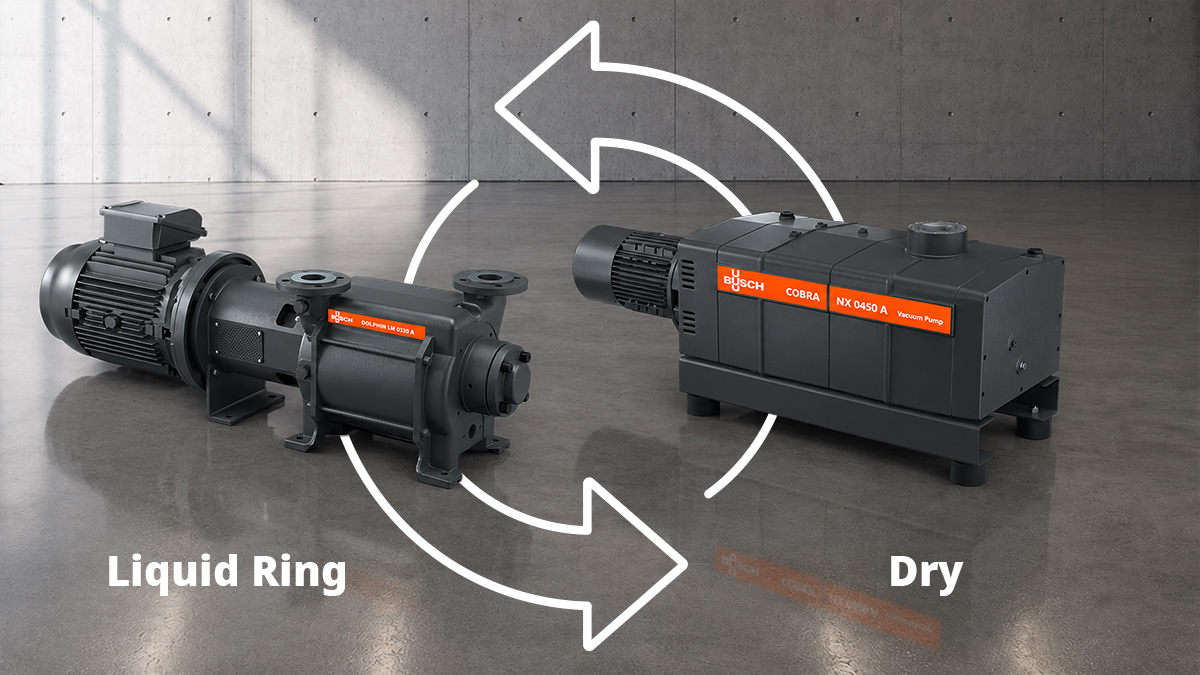
Switching from a liquid ring to a dry vacuum pump is more than a component change. It is an opportunity to rethink the entire vacuum infrastructure. Source: Busch Vacuum Solutions.
MAULBURG, GERMANY, October 6, 2026 /EINPresswire.com/ -- Why the change matters
Vacuum technology underpins nearly every process in plastics manufacturing. From extrusion and compounding to drying, thermoforming, and recycling. For decades, liquid ring vacuum pumps (LRPs) were the industrial standard thanks to their simplicity and tolerance to moisture and solids.
Today, however, many processors are rethinking this choice. Rising water and energy costs, stricter environmental standards, and the growing adoption of centralized vacuum systems make dry vacuum pumps an attractive alternative.
Upgrading can deliver higher efficiency, lower lifetime cost, and a cleaner process environment. But only if the transition is engineered correctly. The following points summarize what to consider before making the switch.
1. Understand the process gas composition
Dry vacuum pumps work without sealing fluid, so they are more sensitive to vapors and particulates. Assess the type, quantity, and behavior of the process gases, including monomers, additives, and moisture.
High vapor loads may require pre-condensers or hybrid systems. Condensable vapors must be separated before they enter the pump to prevent internal condensation. For reactive or corrosive gases, consider specialized materials or gas flushing cycles. Polymerizing compounds need particular attention to prevent buildup inside the pump.
2. Redesign the inlet protection
In liquid ring systems, the circulating fluid performs natural separation of liquids and solids. When switching to dry technology, this function must be replaced with mechanical protection:
• Gas scrubber or knockout pots capture slugs or condensate.
• Standing filters, like cyclone and demister remove particulates.
• Separators (chilled pre-condensers) handle volatile vapors.
Proper separation ensures reliable operation and extends vacuum pump lifetime. The protection system should be designed based on the worst-case process conditions, not average operation.
3. Match pressure range and capacity to the process
LRPs are tolerant of load variations, but dry vacuum pumps are more precise devices. Verify that the selected model delivers the required pumping speed and ultimate pressure under worst-case conditions.
Pumping speed ratings are pressure-dependent. Check performance curves at your actual operating point rather than relying on nominal ratings.
Stable vacuum control is critical. If the vacuum level is too low, degassing or drying becomes inefficient. If it is too high, volatile components that should remain in the material may be removed, or the process can become unstable.
For deep vacuums or fluctuating gas loads, a booster stage or variable speed drive may be needed to stabilize performance. Consider whether the process requires continuous operation or cyclic pump-down, as this significantly affects sizing and control requirements.
4. Manage heat and exhaust conditions
Dry pumps have no cooling liquid and therefore discharge significantly hotter gases than liquid ring systems. Ensure adequate ventilation and, if necessary, use air or water-cooled variants. Unlike liquid ring pumps, which provide a certain gas washing effect, dry technologies may require additional exhaust gas treatment depending on the process.
• In closed production areas, exhaust gases should be piped outside or through heat recovery systems to avoid excess heat load.
• Water-cooled models reduce discharge temperatures but add cooling infrastructure requirements.
• Consider whether exhaust gas cleaning is required, as dry systems do not inherently remove contaminants.
• If using oil-lubricated pump designs, ensure appropriate oil mist filtration and separation, as condensate and oil may need to be handled as waste.
5. Adapt control and automation
This is where dry vacuum technology truly excels. Integrating pressure transmitters and variable speed drives allows vacuum pumps to run only when needed, minimizing energy consumption. The pump modulates capacity based on actual process demand, while pressure-based control maintains stable vacuum levels with less energy waste. While modern liquid ring pumps can also be operated with frequency converters, dry technologies typically respond more efficiently to variable speed control due to their operating principle.
Integration with existing process control systems requires updated logic and interlocks. This shift from a steady-state to demand-driven operation may require training for engineers and operators during the transition. When well implemented, users can achieve energy savings typically ranging from 30-60% depending on application and control strategy, particularly in processes with varying vacuum requirements.
6. Plan for maintenance and accessibility
Although dry pumps are nearly maintenance-free, accessibility is essential for gear oil changes or flushing cycles, and, where applicable, filter replacements.
Allow space for service and ensure good ventilation around the pump. Dry systems are quieter than liquid ring units but may still need vibration dampening when used in centralized systems.
7. Evaluate total cost-of-ownership
While initial investment is typically higher, dry vacuum technology provides rapid payback through:
• Lower energy demand due to higher efficiency and better load matching
• No cooling water or wastewater handling eliminates associated costs and environmental compliance
• Reduced maintenance time and consumables with longer service intervals
• Longer service life and uptime with fewer process interruptions
A full cost analysis over several years almost always favors dry technology, particularly where energy or water costs are significant. Include utility rates, maintenance labor, and environmental compliance costs in your evaluation.
Conclusion
Switching from a liquid ring to a dry vacuum pump is more than a component change. It's an opportunity to rethink the entire vacuum infrastructure. With proper inlet protection, process-matched selection, and control system integration, dry technology offers a cleaner, more efficient, and sustainable solution for modern plastics production.
The key to successful implementation lies in thorough process analysis and system-level engineering rather than simple component replacement.
Dr Sandra Thirtle-Höck
Busch Group
+49 418021460
Legal Disclaimer:
EIN Presswire provides this news content "as is" without warranty of any kind. We do not accept any responsibility or liability for the accuracy, content, images, videos, licenses, completeness, legality, or reliability of the information contained in this article. If you have any complaints or copyright issues related to this article, kindly contact the author above.
